 |
|
|
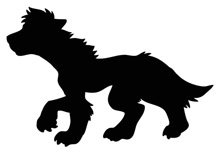
The kendavi, namesake of this site, are a species I created years ago, and recently began developing. I'll keep updating this as time goes on. The Kendavi 0 ●Basic Physical: short, fine build
with strong limbs; digitigrade hind legs; short, blunt muzzle, small, slightly
rounded ears*; reddish brown to reddish tawny in colouration; faint markings on
muzzle, ears, or legs (see Figure 0.1) Height: ranges from 3’2”-4’8” (feet) Weight: ranges from 45-70lbs Mutations: *taller, less rounded ears occur every 1/20
individuals Lifespan: 50-70 years (Inner Continent); 60-90 (more forgiving
climates) Community: live
in small packs/tribes dispersed throughout plains region (Inner Continent) Location: vast,
arid grasslands and gorge region of the Inner Continent Religion: not strictly
organized, but does share common threads across territory; many parallels exist
between Kendavi and sousaku ‘religion’ 1 ●Lifestyle The Kendavi live in small,
loosely-clustered ‘tribes’, dispersed freely throughout the region of the
grasslands and gorge regions of the Inner Continent of Afthellafelle. These tribes do not always consist of
directly related members, due to the nomadic nature of Kendavi lifestyle, in
addition to the Kendavi propensity for travel.
Their society is neither strictly patriarchal nor matriarchal, and there
is no apparent ‘head’ of their race.
Although not technically anarchists, the Kendavi do not appoint council
elders, tribal leaders, or other such functionaries of governance. Instead, the species appears to exist with
only mild friction between its members and various groups. The population count of the Kendavi is rather
low when compared to the populations of other species in similar or smaller
geographic regions. Much of Kendavi life
centers around the constant, high winds of their
region, which is predominantly mild to cold, and quite arid. Harnessing
the Wind The Kendavi are masters at adapting to
inclement conditions, twisting the high winds to their advantage. All other species have been unable to survive
due primarily to the wind, lack of water, and wind chill factor, but the
Kendavi have used the wind to travel speedily across their large territory, using
sled-rigged ships to ‘sail’ (see Figure 1.1).
There are perhaps seven to twelve large ships currently in operation, serving
a crew of four to eight, although smaller ‘dinghy’ class ships exist, with
crews of one to three. To gain more
surface area for the sails, and thus more speed, the larger ships will often
attach one or two satellite dinghies to their sides. In the case of the larger ships, which are
not privately ‘owned’, crew changes constantly, with every occupant fulfilling
a function. The
only member who is consistently running the ship is the head navigator, and
sometimes the head lookout. The small dinghies,
serving crew/passengers of one to three members are generally privately crafted
and owned, and used solely for short-distance transport, often of supplies. |